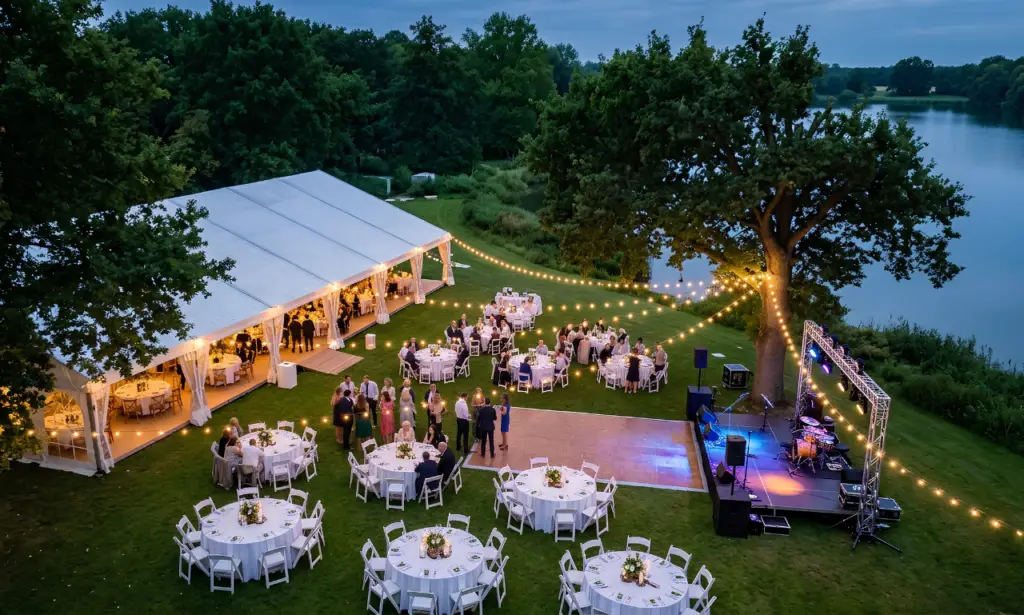
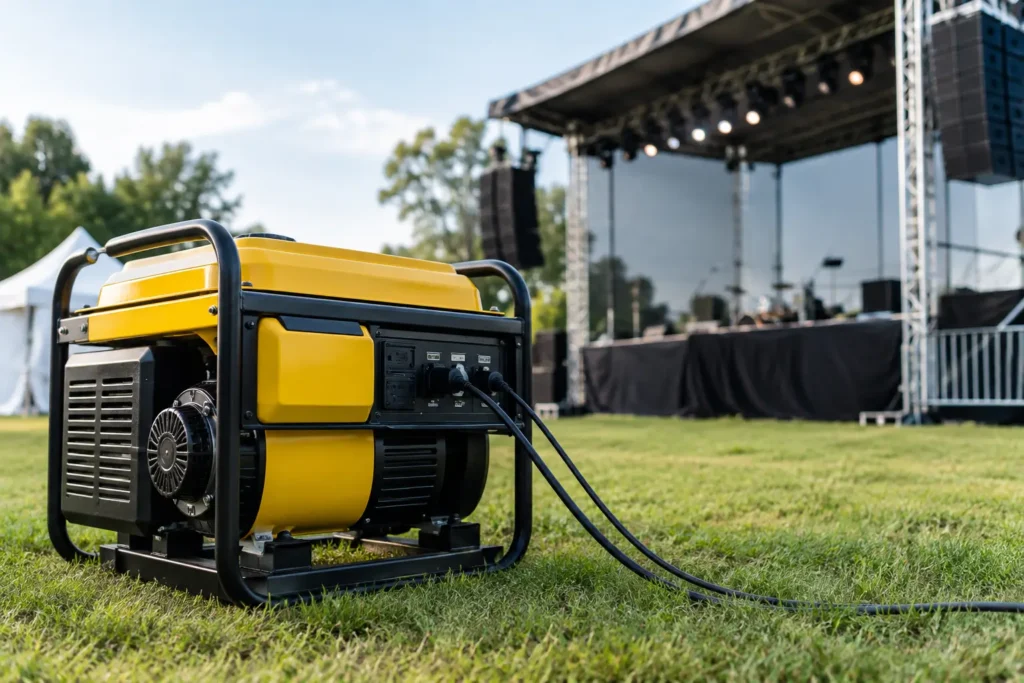
A generator can be supplying clean, reliable power and still become the reason a neighbor calls, a permit is delayed, or a quiet wedding ceremony loses its atmosphere. Generator noise limits are not an afterthought for outdoor events. They affect where equipment can sit, what size unit you hire, when it can operate, and how the entire site is laid out.
For a backyard party, the issue may be a nearby bedroom window. For a corporate launch, festival, school formal, or wedding, it may be a venue condition or local permit requirement. The right approach is simple: confirm the rule early, build the power plan around it, and test the setup before guests arrive.
Why generator noise limits matter on event sites
Generators produce more than a steady background hum. Engine speed, electrical load, enclosure design, exhaust direction, ground conditions, and surrounding buildings all change what people hear. A unit that seems quiet in an open warehouse yard can sound far louder when it is placed beside a fence, between marquees, or against the wall of a neighboring property.
Noise also becomes more noticeable when the event itself has quiet moments. Think wedding vows, speeches, presentations, acoustic music, memorial events, or a dinner service held after dark. Even a compliant generator can be a poor guest experience if it is positioned too close to the action.
The practical risk is not limited to complaints. Venues and local authorities may set conditions around operating hours, equipment placement, or maximum noise at a property boundary. If the power system has been planned late, moving a generator can mean longer cable runs, added cable protection, revised access routes, or a change to the distribution layout.
That is why power, sound, structures, and guest areas should be planned together. A generator is not a standalone rental item. It is part of the event infrastructure.
Start with the actual generator noise limit
There is no single noise number that applies to every event. Requirements can vary by city, county, venue, zoning, permit conditions, event hours, and the type of neighborhood surrounding the site. A park booking may have one set of conditions. A private property, school, loading dock, or public street closure may have another.
Ask the venue or permitting authority what standard applies before selecting equipment. Get clarity on whether the limit is measured at the generator, at a defined distance, or at the property line. Those are very different measurements. A specification stating that a generator produces a certain sound level at 23 feet does not automatically prove it meets a boundary limit several hundred feet away, especially if the site reflects or channels sound.
Confirm how and when noise is measured
Most event noise rules use A-weighted decibels, written as dBA, because that measurement broadly reflects how people hear sound. But the number alone is not enough. The measurement location, averaging period, and time of day matter just as much.
A daytime allowance may not apply after evening hours. A limit measured at the closest residence can be stricter than one measured within the event footprint. Some approvals also treat amplified music, generators, crowd noise, and vehicle movement as separate sources. Do not assume that an allowance for music covers plant and equipment.
Put the requirement in the event brief alongside access times, site curfews, electrical load, emergency routes, and wet-weather plans. It gives the production team a clear design target rather than leaving a critical decision to show day.
Check the conditions beyond the permit
A permit is not always the whole story. Property managers, venues, homeowners associations, campuses, and sports grounds can impose their own operating conditions. They may restrict generator locations, require cable ramps across public paths, or prohibit running equipment overnight.
If the event has a sensitive neighbor, it is also worth planning communication. A clear notice about setup times and event hours can prevent a surprise from becoming a complaint. That does not replace compliance, but it helps keep the operation smooth.
Build a quieter power plan from the start
The best noise control is often good power planning, not an improvised barrier after the generator arrives. Start with a realistic load calculation for lighting, catering, audio, AV, heating, refrigeration, staging, and any vendor equipment. Then account for startup loads and the operating pattern across the day.
Choose the right generator size
Oversizing creates its own problems. A large generator running lightly loaded can be inefficient, and it may create more noise than the event needs. Undersizing is worse: the generator may struggle with startup demand, trip protection, or force last-minute changes to the power plan.
The answer is not simply to choose the smallest quiet unit available. It is to select a properly sized, enclosed generator with suitable distribution and enough capacity for peak demand. For larger sites, separating power zones can be smarter than feeding every service from one distant unit. It may reduce cable runs and allow the generator locations to be chosen with noise control in mind.
Where practical, battery storage or a hybrid power system can reduce generator run time during low-demand periods. This can be particularly useful for overnight security lighting, low-level site power, or quiet periods between event sessions. It depends on the load profile and available equipment, but it is worth considering when curfews are tight.
Put distance and direction to work
Distance is one of the most effective tools available. Locate the generator as far as practical from guests, residences, ceremony spaces, dining areas, backstage dressing rooms, and microphones. Keep vehicle access, refueling needs, ventilation, and emergency access in the plan.
Direction matters too. Avoid pointing exhaust outlets or cooling airflow toward seating, neighboring homes, or enclosed structures. Do not tuck a generator into a poorly ventilated corner simply because it is out of sight. Equipment needs safe clearance and airflow to operate correctly.
A site map should show the generator, distribution board, cable routes, fuel access, stages, marquees, food service, guest zones, and nearby sensitive boundaries. This is where a coordinated hire plan saves time. Zero Three Party & Event Hire can align power equipment with staging, structures, lighting, and the rest of the site setup rather than treating each item as a separate delivery.
Use distribution to protect the layout
Long cable runs are sometimes necessary to move a generator away from the event. When they are, cable routing must be planned properly. Keep cables out of guest walkways where possible. Use appropriate cable protection where crossings cannot be avoided, and do not create trip hazards or block wheelchair access, emergency exits, or service routes.
The goal is not to hide every cable. The goal is to create a safe, serviceable system that lets the generator sit where it causes the least disruption.
Do not rely on makeshift sound barriers
A fence, trailer, wall, or purpose-designed acoustic screen can sometimes reduce direct noise transmission. But barriers only work when they are correctly positioned, sized, and safe for the site. They are not a license to place a generator beside a neighbor or behind the stage.
Never wrap a generator in fabric, stack equipment around ventilation openings, or build a temporary enclosure without professional guidance. Restricted airflow can cause overheating, exhaust hazards, equipment failure, and fire risk. Sound treatment must never compromise ventilation, access, fuel safety, or manufacturer clearances.
A quieter generator, thoughtful placement, sensible loading, and proper cable distribution usually deliver better results than trying to fix a noisy setup with temporary materials.
Test the setup before guests arrive
A sound check should include the generator. Once the site is built, run the likely event load and listen from the places that matter: the ceremony area, presentation space, dining zone, neighboring boundary, and nearby residences where access is permitted.
Check again when catering equipment, HVAC, lighting, and audio systems switch on. A generator may sound different at higher load, and new equipment can reveal vibration or exhaust issues that were not obvious during setup.
Keep a clear point of contact for power issues during the event. If a unit needs refueling, servicing, or adjustment, the crew should know who authorizes access and how guests will be protected. On larger events, this belongs in the site operations plan, not in a text message thread.
Good generator planning is quiet work done early. Confirm the rule, map the site, calculate the load, and give the equipment enough room to operate safely. Your guests may never notice the power system at all, which is exactly how it should be.